Welcome to DU!
The truly grassroots left-of-center political community where regular people, not algorithms, drive the discussions and set the standards.
Join the community:
Create a free account
Support DU (and get rid of ads!):
Become a Star Member
Latest Breaking News
Editorials & Other Articles
General Discussion
The DU Lounge
All Forums
Issue Forums
Culture Forums
Alliance Forums
Region Forums
Support Forums
Help & Search
Science
Related: About this forum
SOAR Telescope Catches Dimorphos's Expanding Comet-like Tail After DART Impact
NOIRLab-operated SOAR telescope reveals immense trail of debris from collision with asteroid Dimorphos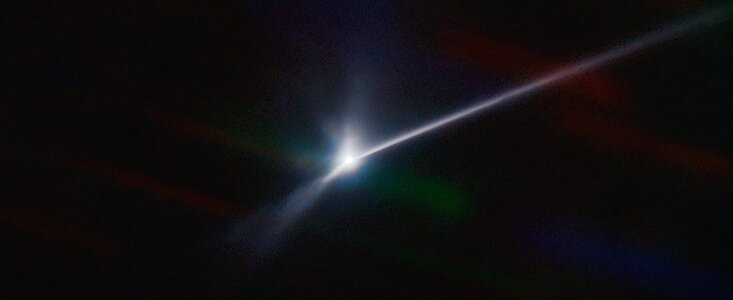
NASA’s Double Asteroid Redirection Test (DART) spacecraft intentionally crashed into Dimorphos, the asteroid moonlet in the double-asteroid system of Didymos, on Monday 26 September 2022. This was the first planetary defense test in which an impact of a spacecraft attempted to modify the orbit of an asteroid.
Two days after DART’s impact, astronomers Teddy Kareta (Lowell Observatory) and Matthew Knight (US Naval Academy) used the 4.1-meter Southern Astrophysical Research (SOAR) Telescope [1], at NSF’s NOIRLab's Cerro Tololo Inter-American Observatory in Chile, to capture the vast plume of dust and debris blasted from the asteroid’s surface. In this new image, the dust trail — the ejecta that has been pushed away by the Sun’s radiation pressure, not unlike the tail of a comet — can be seen stretching from the center to the right-hand edge of the field of view, which at SOAR is about 3.1 arcminutes using the Goodman High Throughput Spectrograph. At Didymos's distance from Earth at the time of the observation, that would equate to at least 10,000 kilometers (6000 miles) from the point of impact.
“It is amazing how clearly we were able to capture the structure and extent of the aftermath in the days following the impact,” said Kareta.
Two days after DART’s impact, astronomers Teddy Kareta (Lowell Observatory) and Matthew Knight (US Naval Academy) used the 4.1-meter Southern Astrophysical Research (SOAR) Telescope [1], at NSF’s NOIRLab's Cerro Tololo Inter-American Observatory in Chile, to capture the vast plume of dust and debris blasted from the asteroid’s surface. In this new image, the dust trail — the ejecta that has been pushed away by the Sun’s radiation pressure, not unlike the tail of a comet — can be seen stretching from the center to the right-hand edge of the field of view, which at SOAR is about 3.1 arcminutes using the Goodman High Throughput Spectrograph. At Didymos's distance from Earth at the time of the observation, that would equate to at least 10,000 kilometers (6000 miles) from the point of impact.
“It is amazing how clearly we were able to capture the structure and extent of the aftermath in the days following the impact,” said Kareta.
https://noirlab.edu/public/news/noirlab2223/
2 replies
 = new reply since forum marked as read
Highlight:
NoneDon't highlight anything
5 newestHighlight 5 most recent replies
= new reply since forum marked as read
Highlight:
NoneDon't highlight anything
5 newestHighlight 5 most recent replies
= new reply since forum marked as read
Highlight:
NoneDon't highlight anything
5 newestHighlight 5 most recent replies
SOAR Telescope Catches Dimorphos's Expanding Comet-like Tail After DART Impact (Original Post)
Ptah
Oct 2022
OP
I'm surprised that it will take two months to see if trajectory changes . . .
Mr.Mystery
Oct 2022
#1

Mr.Mystery
(185 posts)1. I'm surprised that it will take two months to see if trajectory changes . . .
You'd think they could measure a shift right away.

LastDemocratInSC
(4,242 posts)2. They must time the period of eclipses of Didymos by Dimorphos.
Many orbits are required to get the precise timing because they are looking at light curves instead of hard off-on times.