Welcome to DU!
The truly grassroots left-of-center political community where regular people, not algorithms, drive the discussions and set the standards.
Join the community:
Create a free account
Support DU (and get rid of ads!):
Become a Star Member
Latest Breaking News
Editorials & Other Articles
General Discussion
The DU Lounge
All Forums
Issue Forums
Culture Forums
Alliance Forums
Region Forums
Support Forums
Help & Search
Environment & Energy
Related: About this forum
White hydrogen discovered in billion-year-old Canadian Shield rock points to potential new energy source
https://www.eurekalert.org/news-releases/1128340News Release 18-May-2026
White hydrogen discovered in billion-year-old Canadian Shield rock points to potential new energy source
Peer-Reviewed Publication
University of Toronto
May 14, 2026
TORONTO, ON – Within the Canadian Shield, hydrogen gas is steadily building up naturally among some of the oldest rocks on Earth. Now, for the first time, geochemists at the University of Toronto and the University of Ottawa have measured its presence, mapped its concentration and tracked its long-term accumulation, shedding new light on this source of natural, or white, hydrogen.
The findings make it possible to assess the economic viability of this emerging energy source and point to a new approach to hydrogen exploration — one that could accelerate greenhouse gas reductions and expand hydrogen’s role in the clean energy
transition.
A study published in the Proceedings of the National Academy of Sciences reports measurements of hydrogen directly observed discharging from the vast billion-year-old rocks of the Canadian Shield. Using data from an operating mine near Timmins, Ontario, the researchers show that boreholes at the site release an average of 0.008 tonnes of hydrogen per year – approximately 8 kilograms, which is the weight of an average-sized car battery – and can continue to do so for 10 years or more.
Extrapolating to the site’s nearly 15,000 boreholes results in a total discharge of more than 140 tonnes of hydrogen per year. Such discharges could provide 4.7 million kilowatts of energy per year from a single location – enough to support the annual energy needs of over 400 households.
…
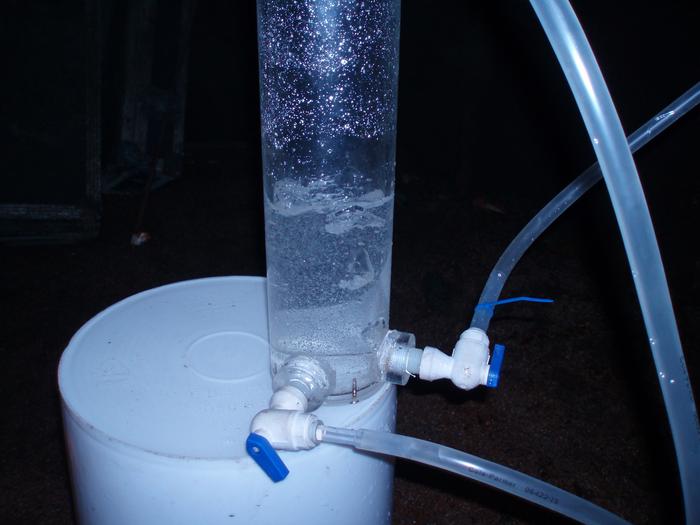
Natural hydrogen visible as gas bubbles separating from groundwater discharging from rocks of the Canadian Shield. Credit: Courtesy of Barbara Sherwood Lollar
…
White hydrogen discovered in billion-year-old Canadian Shield rock points to potential new energy source
Peer-Reviewed Publication
University of Toronto
May 14, 2026
TORONTO, ON – Within the Canadian Shield, hydrogen gas is steadily building up naturally among some of the oldest rocks on Earth. Now, for the first time, geochemists at the University of Toronto and the University of Ottawa have measured its presence, mapped its concentration and tracked its long-term accumulation, shedding new light on this source of natural, or white, hydrogen.
The findings make it possible to assess the economic viability of this emerging energy source and point to a new approach to hydrogen exploration — one that could accelerate greenhouse gas reductions and expand hydrogen’s role in the clean energy
transition.
A study published in the Proceedings of the National Academy of Sciences reports measurements of hydrogen directly observed discharging from the vast billion-year-old rocks of the Canadian Shield. Using data from an operating mine near Timmins, Ontario, the researchers show that boreholes at the site release an average of 0.008 tonnes of hydrogen per year – approximately 8 kilograms, which is the weight of an average-sized car battery – and can continue to do so for 10 years or more.
Extrapolating to the site’s nearly 15,000 boreholes results in a total discharge of more than 140 tonnes of hydrogen per year. Such discharges could provide 4.7 million kilowatts of energy per year from a single location – enough to support the annual energy needs of over 400 households.
…
Natural hydrogen visible as gas bubbles separating from groundwater discharging from rocks of the Canadian Shield. Credit: Courtesy of Barbara Sherwood Lollar
…
Decadal record of continental H₂ reservoirs reveals potential for subsurface microbial life and natural H₂ exploration
Barbara Sherwood Lollar barbara.sherwoodlollar@utoronto.ca and Oliver Warr https://orcid.org/0000-0001-8240-7979Authors Info & Affiliations
Contributed by Barbara Sherwood Lollar; received February 2, 2026; accepted April 13, 2026; reviewed by Steven D’Hondt, Steve E. Ingebritsen, and Norman H. Sleep
This contribution is part of the special series of Inaugural Articles by members of the National Academy of Sciences elected in 2022.
May 18, 2026
123 (21) e2603895123
https://doi.org/10.1073/pnas.2603895123
Significance
This study presents, to our knowledge, the first long-term decadal record of hydrogen discharge rates from a Precambrian continental setting. The data demonstrate hydrogen production and storage sufficient to potentially sustain economically viable discharge rates. The findings suggest the opportunity for an alternative approach to traditional natural hydrogen exploration–focusing on the global network of data from sites where hydrogen has already been documented, and evaluation of site-specific hydrogen potential via direct point-source measurement of concentrations and rates (as in this study), or via ventilation exhaust measurements. Applying this strategy, there is potential for society to capitalize on what has long been a primary energy source for subsurface microbiology and for research focused on habitability and astrobiology.
Abstract
Interest in the economic potential for hydrogen for decarbonization and the green energy transition is a recent phenomenon. Major questions remain concerning the concentrations, volumes, and sustainability of potential reservoirs, as projections to date are largely theoretical models rather than empirical data. This study integrates previously unpublished long-term data for natural hydrogen production from serpentinization and radiolysis, with research carried out during investigations of the deep subsurface biosphere. The results provide constraints on the volume of natural hydrogen available in the crust and the rates of potential discharge. Discharge rates of >140 tonnes of hydrogen per year from a site in Canada suggest ~4.7 million kwH of energy from hydrogen per year could be available from a single mine location. These data indicate that large discharges of hydrogen may be sustainable in the long-term based on monitoring to date from 1 to >10 y. Calculations from this study site show that the amount of locally generated energy has economic value for both industries and communities located on hydrogen-producing rock. Given that >70% of the continental crust has the potential for hydrogen generation, such local/regional use of this energy source is an unexplored opportunity, in addition expanding our understanding of the habitability of Earth and beyond. We present an alternative vision for the hydrogen economy that can address some of the current challenges arising from the focus to date, that has been largely based on transportation of hydrogen over long distances from source location to markets.
…
Barbara Sherwood Lollar barbara.sherwoodlollar@utoronto.ca and Oliver Warr https://orcid.org/0000-0001-8240-7979Authors Info & Affiliations
Contributed by Barbara Sherwood Lollar; received February 2, 2026; accepted April 13, 2026; reviewed by Steven D’Hondt, Steve E. Ingebritsen, and Norman H. Sleep
This contribution is part of the special series of Inaugural Articles by members of the National Academy of Sciences elected in 2022.
May 18, 2026
123 (21) e2603895123
https://doi.org/10.1073/pnas.2603895123
Significance
This study presents, to our knowledge, the first long-term decadal record of hydrogen discharge rates from a Precambrian continental setting. The data demonstrate hydrogen production and storage sufficient to potentially sustain economically viable discharge rates. The findings suggest the opportunity for an alternative approach to traditional natural hydrogen exploration–focusing on the global network of data from sites where hydrogen has already been documented, and evaluation of site-specific hydrogen potential via direct point-source measurement of concentrations and rates (as in this study), or via ventilation exhaust measurements. Applying this strategy, there is potential for society to capitalize on what has long been a primary energy source for subsurface microbiology and for research focused on habitability and astrobiology.
Abstract
Interest in the economic potential for hydrogen for decarbonization and the green energy transition is a recent phenomenon. Major questions remain concerning the concentrations, volumes, and sustainability of potential reservoirs, as projections to date are largely theoretical models rather than empirical data. This study integrates previously unpublished long-term data for natural hydrogen production from serpentinization and radiolysis, with research carried out during investigations of the deep subsurface biosphere. The results provide constraints on the volume of natural hydrogen available in the crust and the rates of potential discharge. Discharge rates of >140 tonnes of hydrogen per year from a site in Canada suggest ~4.7 million kwH of energy from hydrogen per year could be available from a single mine location. These data indicate that large discharges of hydrogen may be sustainable in the long-term based on monitoring to date from 1 to >10 y. Calculations from this study site show that the amount of locally generated energy has economic value for both industries and communities located on hydrogen-producing rock. Given that >70% of the continental crust has the potential for hydrogen generation, such local/regional use of this energy source is an unexplored opportunity, in addition expanding our understanding of the habitability of Earth and beyond. We present an alternative vision for the hydrogen economy that can address some of the current challenges arising from the focus to date, that has been largely based on transportation of hydrogen over long distances from source location to markets.
…