General Discussion
Related: Editorials & Other Articles, Issue Forums, Alliance Forums, Region ForumsThe History of Skulls in Tattooing: A Symbol of Life, Death, and Everything In Between
Tattoos have been a form of expression for centuries, with designs reflecting cultural beliefs, personal experiences, and societal values. Among the myriad of tattoo motifs, skulls stand out as one of the most enduring and evocative symbols. Their significance transcends time and geography, intertwining with themes of mortality, transformation, and rebellion. In this blog post, we’ll explore the history of skulls in tattooing and their evolving meanings.
Ancient Roots
The use of skull imagery in body art can be traced back to ancient civilizations. In many cultures, skulls represented not only death but also the cycle of life. For example, the Aztecs celebrated death as an integral part of life, and skull motifs adorned various artifacts, including tattoos. Similarly, in Polynesian culture, tattoos were used to signify status, bravery, and even ancestry. The incorporation of skulls into tattoos was a way to honor the dead and connect with ancestral spirits.
Maritime Traditions
In the 18th and 19th centuries, skull tattoos gained popularity among sailors. The infamous Jolly Roger—a skull and crossbones flag—became synonymous with piracy. Sailors often tattooed skulls as symbols of fearlessness and as a reminder of their mortality while at sea. The design became a badge of honor, representing a life of adventure and the acceptance of death as a constant companion.
The Rise of the American Traditional Style
The early 20th century saw a resurgence of skull tattoos in American traditional tattooing. Artists like Norman “Sailor Jerry” Collins helped popularize the style, which featured bold lines and vivid colors. Skulls in this era often conveyed themes of rebellion, with designs incorporating elements like roses, daggers, and flames. This combination of imagery created a powerful contrast between beauty and death, encapsulating the transient nature of life.
The Counterculture Movement
The 1960s and 70s brought about significant cultural shifts, and skull tattoos became emblematic of the counterculture movement. Associated with rebellion against societal norms, skulls were often embraced by rock musicians and bikers, symbolizing freedom and individuality. Bands like the Grateful Dead popularized skull imagery, turning it into an icon of a generation that embraced nonconformity and a more hedonistic lifestyle.
Modern Interpretations
Today, skull tattoos are more diverse than ever. They continue to symbolize death, but they also represent strength, resilience, and a celebration of life. Contemporary artists experiment with styles ranging from hyper-realistic depictions to abstract interpretations, often incorporating cultural or personal elements that give the skull new meaning.
Cultural Sensitivity and Appropriation
As the popularity of skull tattoos expands globally, it’s essential to acknowledge cultural sensitivity and the potential for appropriation. While skulls have universal appeal, their meanings can vary significantly across different cultures. Understanding the origins and significance of skull designs is crucial for those considering getting a skull tattoo, ensuring that it is respectful and meaningful.
Conclusion
From ancient rituals to modern artistry, the history of skulls in tattooing reflects humanity’s complex relationship with life and death. These striking symbols continue to captivate and inspire, inviting us to contemplate our mortality while celebrating the beauty of existence. Whether you view skulls as a sign of rebellion, a tribute to lost loved ones, or a reminder of the impermanence of life, their enduring presence in tattoo art serves as a testament to our shared human experience.
https://boartooth.com/the-history-of-skulls-in-tattooing-a-symbol-of-life-death-and-everything-in-between/
___________________________________
One thing about being in the Marine Corps; tip of the spear, "first in, last out," you know that there is a stark possibility that you won't live to be an old person. The thought of death is always in the back of your head.
So you take on symbols as a form of emotional armor, especially when you're young, late teens early twenties.
 = new reply since forum marked as read
Highlight:
NoneDon't highlight anything
5 newestHighlight 5 most recent replies
= new reply since forum marked as read
Highlight:
NoneDon't highlight anything
5 newestHighlight 5 most recent replies

WhiskeyGrinder
(27,288 posts)Taking on a specific symbol used by SS death camp guards is certainly a form of emotional armor I suppose

Uncle Joe
(65,688 posts)If they had taken on the color blue, would that upset you, that we use it?
WhiskeyGrinder
(27,288 posts)Uncle Joe
(65,688 posts)
Celerity
(55,073 posts)Celerity
(55,073 posts)German military
Prussia
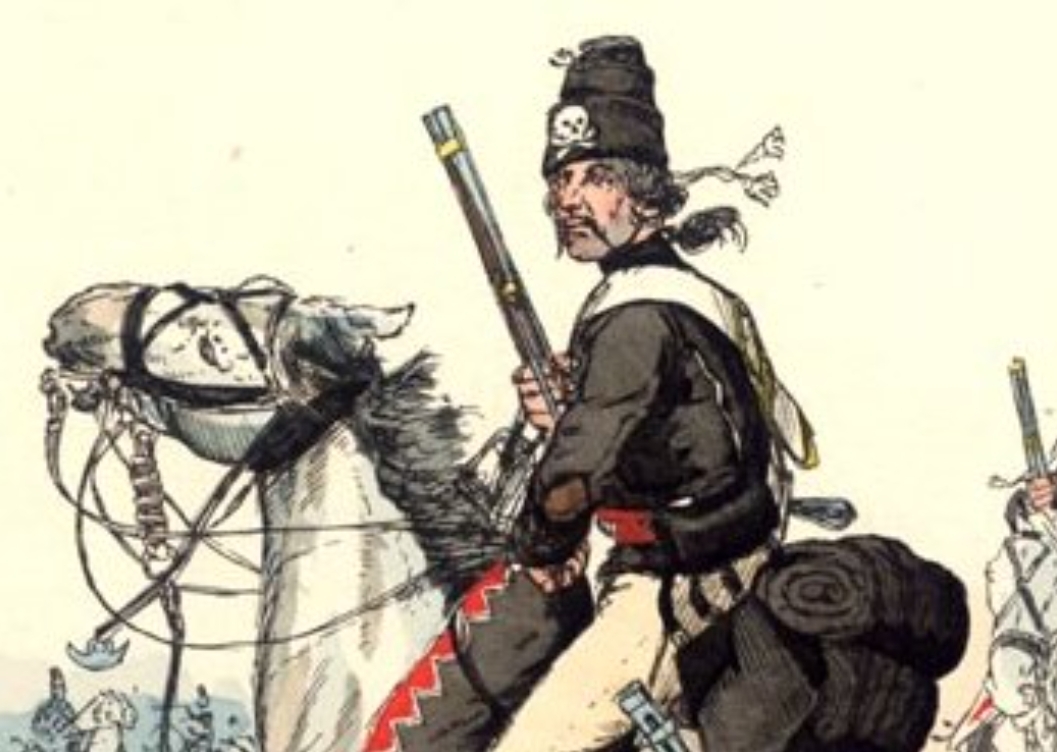
Hussar from Husaren-Regiment Nr. 5 (von Ruesch) in 1744 with the Totenkopf on the mirliton (Ger. Flügelmütze)
Use of the Totenkopf in Germany as a military emblem began under Frederick the Great, who formed a regiment of Hussar cavalry in the Prussian army commanded by Colonel von Ruesch, the Husaren-Regiment Nr. 5 (von Ruesch). It adopted a black uniform with a Totenkopf emblazoned on the front of its mirlitons and wore it on the field in the War of Austrian Succession and in the Seven Years' War.[6] The Totenkopf remained a part of the uniform when the regiment was reformed into Leib-Husaren Regiments Nr.1 and Nr.2 in 1808. The symbol was then granted 3 years later to the Spanish Army’s 8th Light Cavalry Regiment “Lusitania”, who were nicknamed “Los Dragones de la Muerte” (the Dragons of Death) and were granted use of the skull after the infamous Battle of Madonna dell'Olmo in 1744, where they suffered great casualties.

Totenkopf badge worn by the Brunswick Leibbataillon ( "Life-Guard Battalion" ) at the Battle of Waterloo in 1815
Brunswick
In 1809, during the War of the Fifth Coalition, Frederick William, Duke of Brunswick-Wolfenbüttel raised a force of volunteers to fight Napoleon Bonaparte, who had conquered the Duke's lands. The Brunswick Corps was provided with black uniforms, giving rise to their nickname, the Black Brunswickers. Both hussar cavalry and infantry in the force wore a Totenkopf badge, either in mourning for the duke's father, Charles William Ferdinand, Duke of Brunswick-Wolfenbüttel, who had been killed at the Battle of Jena–Auerstedt in 1806, or according to some sources, as a sign of revenge against the French. After fighting their way through Germany, the Black Brunswickers entered British service and fought with them in the Peninsular War and at the Battle of Waterloo. The Brunswick corps was eventually incorporated into the Prussian Army in 1866.

German Empire era Totenkopf
German Empire
The skull continued to be used by the Prussian and Brunswick armed forces until 1918, and some of the stormtroopers that led the last German offensives on the Western Front in 1918 used skull badges. Luftstreitkräfte fighter pilots Georg von Hantelmann and Kurt Adolf Monnington are just two of a number of Central Powers military pilots who used the Totenkopf as their personal aircraft insignia.
Weimar Republic
The Totenkopf was used in Germany throughout the interwar period, most prominently by the Freikorps. In 1933, it was in use by the regimental staff and the 1st, 5th, and 11th squadrons of the Reichswehr's 5th Cavalry Regiment as a continuation of a tradition from the Kaiserreich.
snip
WhiskeyGrinder
(27,288 posts)I forget that people look at Platner's chest tattoo and insist it's not an SS totenkopf. It's certainly not a Leibbataillon or imperial version.
Celerity
(55,073 posts)

Abolishinist
(3,068 posts)regardless of where this might take you, I truly appreciate your positive contribution to DU. Thanks!


luv2fly
(2,730 posts)Clarity can be quite enlightening, but of course the haters won't care.
Thank you for this post.

sarisataka
(22,874 posts)However we can also examine pre-Nazi use of the swastika. It that another symbol we would vehemently defend because it is not unique to the Nazis?

canetoad
(21,087 posts)Blue, in the rest of the world, is the colour of Conservatives - blue bloods. Right wingers adopting blue is a relatively recent event brought about by media entities using blue during the 2000 election.
Why is the Democratic Party associated with the color blue?
The Editors of Encyclopaedia Britannica
The idea of using colors to denote political parties was popularized by TV news broadcasts, which used color-coded maps during presidential elections. However, there was no uniformity in color choices, with different media outlets using different colors. Some followed the British tradition of using blue for conservatives (Republicans) and red for liberals (Democrats). However, during the 2000 U.S. presidential election—and the lengthy battle to determine the winner—prominent news sources denoted Republicans as red and Democrats as blue, and these associations have persisted.
https://www.britannica.com/question/Why-is-the-Democratic-Party-associated-with-the-color-blue

WarGamer
(18,892 posts)We're not talking about a skull tat or a jolly roger...
We're talking about a precise NAZI symbol
Uncle Joe
(65,688 posts)WarGamer
(18,892 posts)Uncle Joe
(65,688 posts)
Iggo
(50,082 posts)Too late now, though. Platner’s our guy.
VOTE FOR PLATNER !!!
sarisataka
(22,874 posts)In support for Democratic candidates in the GE as the effort we have seen in defending Nazi iconography these last couple of months.
If that happens, we will see a blue tsunami
Uncle Joe
(65,688 posts)long as the corporate media doesn't continue enabling people profiting from the highest prescription drug prices in the world to power.
Or they discover that Hitler's favorite color was blue.
sarisataka
(22,874 posts)Than blaming the media.
It is believed Hitler's favorite color was green based on his art. Others have suggested red/black as used by the Nazis however those are also traditional colors associated with Germany.
Hopefully we won't ever have a candidate who picks a good luck symbol for a tattoo that happens to be a cross with bent arms.
Uncle Joe
(65,688 posts)from those same world high prescription drug prices year after year and expect anything to change for the vast majority of the American People.
__________________________
(snip)
Platner also scrutinized Collins for the money she made while in office, saying that becoming a longtime politician has made her a multimillionaire with a strong stock portfolio—two things the average Maine resident doesn’t have.
Open Secrets shows Collins having a net worth of approximately $4.12 million in 2018, aided by nearly $500,000 in assets in the pharmaceutical and electronics industries. But according to the data platform Quiver Quantitive, Collins’ net worth has grown to its current estimate of $6.92 million.
(snip)
https://www.military.com/marine-combat-veteran-graham-platner-wants-susan-collins-senate-seat
So our healthcare is crap as we pay the highest prescription drug prices in the world, and Collins gets a free pass on this issue?
I wonder how many actual skulls were created by these self serving long standing conflicts of interest?
I haven't heard the corporate media cover this issue much.
sarisataka
(22,874 posts)No one needs to tell me about the pay-up-or-die attitude of pharmaceutical companies.
Uncle Joe
(65,688 posts)but the corporate media largely doesn't care because so do they by selling commercials.

Boo1
(509 posts)Without picking one that is specific to the SS.
stumpysbear
(295 posts)
jmbar2
(8,215 posts)You could rehabilitate it with historical references, but Nazi appropriation ensures that it is anathema since WWII.